

The community magazine for the community
Powered by 
The community magazine for the community
Powered by
© Design Courier. Powered by Medelhan. Developed by Broadweb.80
| CANVAS OF PLANS & DRAWINGS |
INTERIOR & DÉCOR, but with a twist |
| HOTELS & RESTAURANTS, beyond mainstream |
Notes on ART |
| Into big AFFAIRS | INSIDERS |
| GLIMPSES | |
Keywords:


“The project began with a gesture rather than a floor plan,” Degraeve explains. “The open, sculptural pivot staircase became the conceptual anchor of the entire penthouse. By carving out that vertical connection, we allowed the two former apartments to truly see each other. It created not only a physical link, but a visual and emotional one.” The staircase channels daylight from a roof window down to the lower level, transforming what might have felt like two stacked units into a continuous, unified home. “Light became the connective element,” he adds. To reinforce this, a Bocci pendant descends through the center of the staircase. “It acts almost like a luminous thread – visually stitching both floors together and creating a magical moment when moving from one level to the other. The experience of transition became just as important as the spaces themselves.”


Rather than preserving the original apartment layouts, Degraeve restructured both floors entirely. “The original identities were dissolved so the home would no longer read as two merged units, but as one narrative unfolding vertically: a space that feels intentional, layered and emotionally coherent.” This approach established the foundation for a home where each level flows naturally into the next, yet retains a distinct atmosphere.

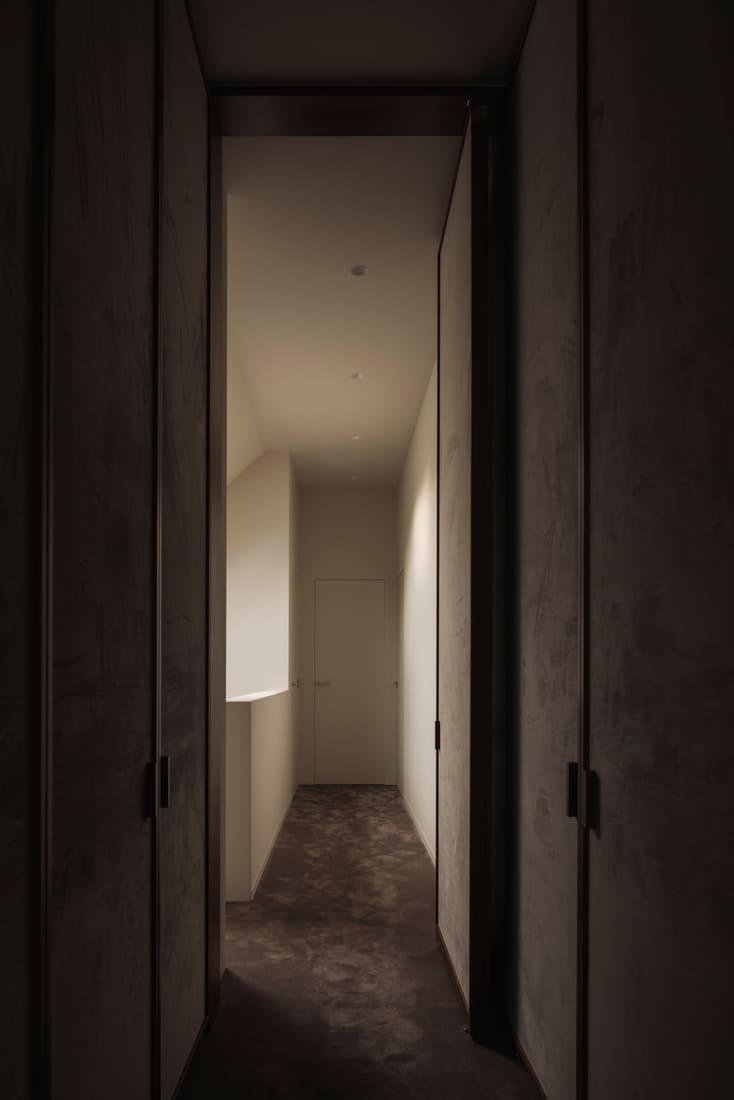
The interiors embrace a layered, seventies-inspired palette, combining aubergine, blush, and warm neutrals with velvet, travertine, walnut veneer, and high-gloss finishes. “The client leads a very intense, high-paced life,” Degraeve explains. “From the beginning, it was clear that the home needed to function as a refuge. We worked with strong architectural lines and structured materials, but deliberately softened them through rounded forms and a restrained, enveloping palette. The aubergine and old-rose tones became central. They bring warmth, sensuality and depth, preventing the harder architectural gestures from feeling cold. Color was used as a counterbalance, almost as an emotional equalizer.”

The kitchen is linear and minimal, grounding the home with a calm base, while the dining and entertainment area carries a more expressive, almost club-like energy. “There we introduced high-gloss veneers, polished finishes and reflective elements, including a mirrored stainless-steel tiled backsplash that subtly recalls the shimmer of a disco ball,” he says. The mid-century-inspired Plattenertafel reinforces that glamour, while aubergine upholstery brings warmth back in, preventing the composition from feeling too sharp. “We often used the same materials in different treatments to maintain coherence. On the entertainment side, finishes are high-gloss and reflective. On the quieter side of the kitchen, those same materials reappear in matte bronze lacquer, matte walnut and travertine. Small details, such as black high-gloss accents in the island, subtly echo the more dramatic side, ensuring the home reads as one continuous story.”

In the private areas, especially the bathroom and dressing, the atmosphere becomes more serene. “Rounded shapes, deeper tones and softened textures create a hammam-like retreat,” Degraeve says. “Moving from the bathroom through the dressing into the bedroom, the experience becomes increasingly tactile: upholstered velvet cabinetry in aubergine, wall cladding, and fixed carpeting create a cocoon. Even there, solid walnut appears again, but carefully balanced between gloss and softness. It’s always about contrast within harmony.”


The kitchen and dining area embody a subtle club sensibility. “A home should contain all dimensions of living, including entertainment, celebration, and a certain theatricality. But it must never lose its warmth. The key was layering intensity without breaking harmony. In the entertainment zone, finishes are more assertive, high-gloss, reflective and bold. In the more private or restful areas, those same materials are treated more softly, matte, tactile and rounded. It’s not about creating a separate ‘club’ room. It’s about allowing that energy to coexist naturally with intimacy and comfort. The house supports both the spectacle of hosting and the quiet of everyday life.”
Art and design are carefully curated throughout. “All bespoke and made-to-measure elements are designed first because they form the architectural backbone of the project. Only once that foundation is established do we begin layering in vintage pieces, design icons and artworks. This selection process is deeply intuitive. We look for what is missing emotionally rather than visually. What tension, what softness, what poetry is still absent?” Degraeve emphasizes that this process continues after completion: “It becomes a living collection, something grown rather than staged. Every piece must hold its own presence, yet feel in dialogue with the bespoke structures.”

Maison Mattelin is described as personal, layered, and slightly theatrical. “The most striking moments in any project often arise from the emotional dialogue with the client. Several choices surprised him. The aubergine fixed carpeting, the upholstered cabinetry, the seating in deep aubergine tones… none of these were initially on his radar. Yet they turned out to resonate profoundly. They brought warmth, softness and sensuality that the client didn’t consciously know he was seeking. The same happened with the sofa. The client imagined something more conventional, but ultimately gravitated toward a bold Edra design that is expressive in form, yet deeply comfortable. It embodied exactly what the project stands for: strength and softness coexisting. It is not purely aesthetic. It is emotional. Maison Mattelin is layered and slightly theatrical, but above all, it is deeply personal. The theatre is never superficial; it emerges from intimacy and trust.”
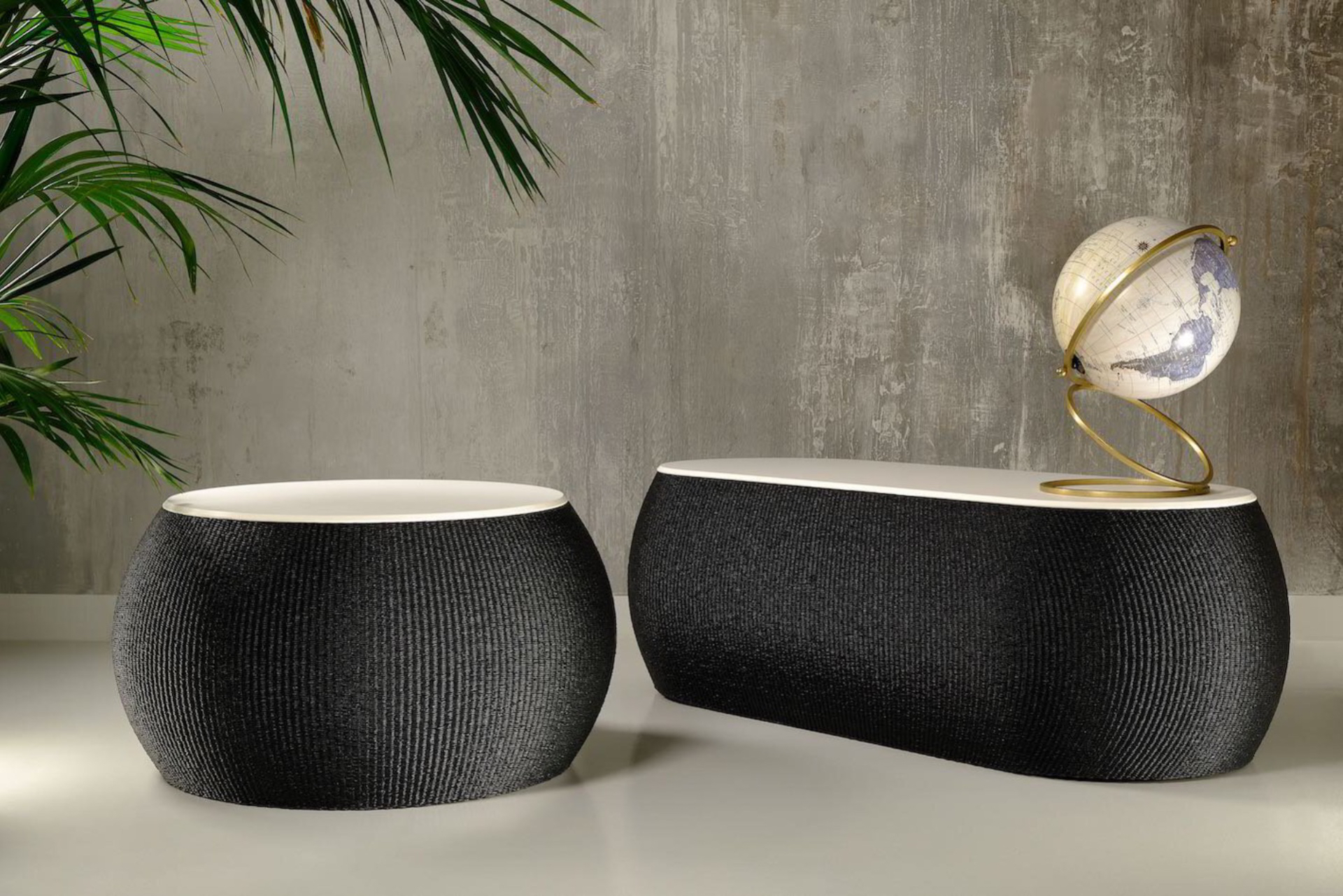
Once upon a time there were crafts workshops. Then came the advent of industrial design and mass production.